| Resolving Shoulder Dystocia |
|
Gail Tully, CPM, became interested in communicating to other midwives and to doctors about Shoulder Dystocia after observing a higher incidence following the labors in which OP babies rotated to OA before emerging. (Incidence is less likely in OP babies who stay OP and emerge OP.) Gail developed a memory tool called FlipFLOP to help birth attendants free the stuck shoulders will little chance of birth injury. Non-drugged birthing women have more options to put their pelvis to work to free the shoulders from the pelvis. Here is how to do it. Most women attended by midwives, and all women having home birth, move freely and adapt various positions to complete the birth. Midwives are mostly women and women have different upper body strength than men. It would be helpful for women birth attendants to learn techniques that give them the leverage to rotate the baby's shoulders free.
There are many ways
Gail Tully, the midwife who hostesses this Spinning Babies Website,
follows the Gaskin's Maneuver with other techniques if still needed. She calls the four techniques she uses FlipFlOP to make it easy to remember: Flip the mom over (this is the Gaskin Manuever); Lift her leg; rotate the shoulder to the Oblique; and bring out the Posterior arm. Email her to get a pdf. file with the FlipFLOP memory hint. Or, click here to Download the single page FlipFLOP pdf file (1.19 mb)
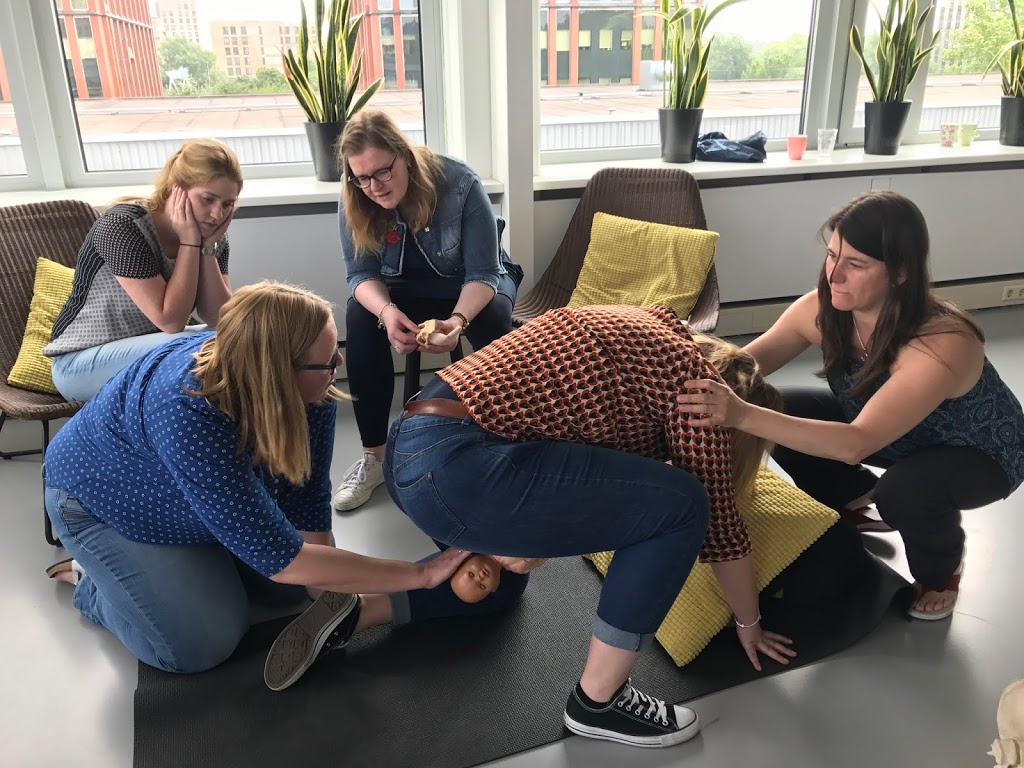
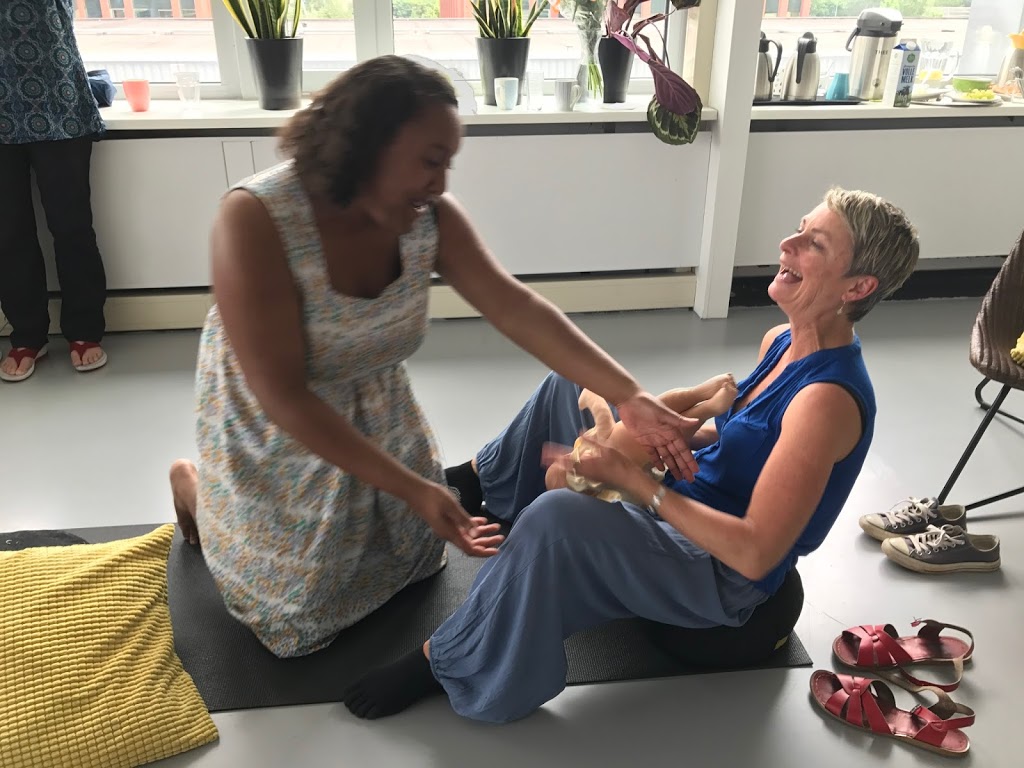
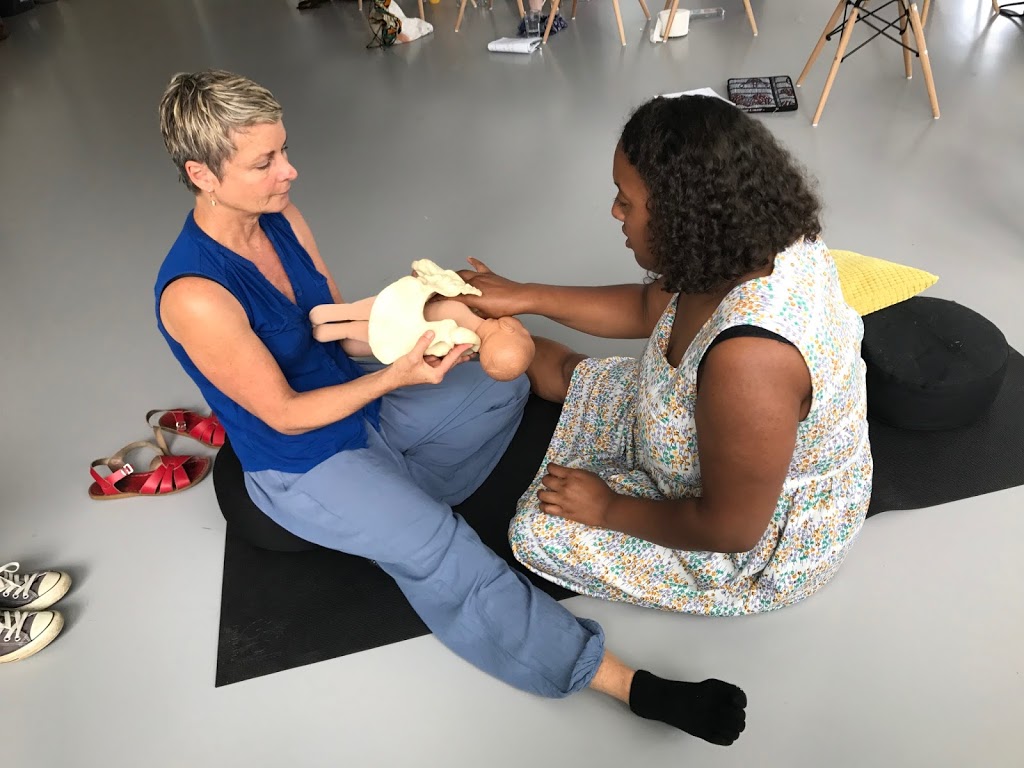
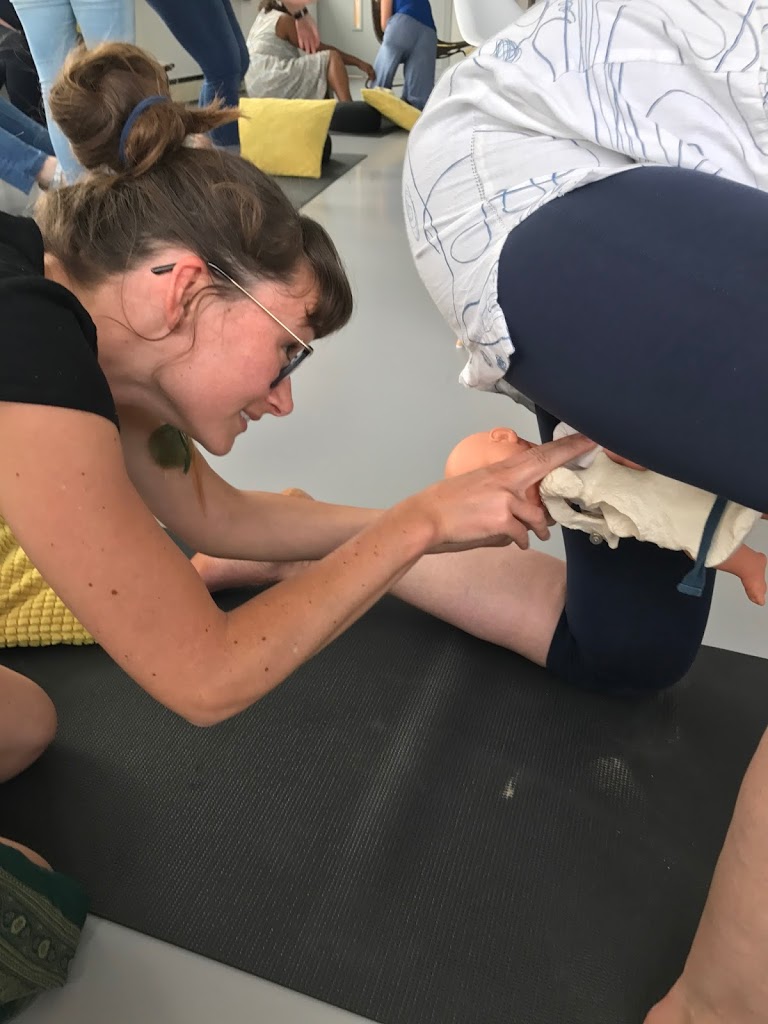
How to use FlipFLOPFirst, help the mom on to her hands and knees. This can be done quickly and even on a hospital bed. Gail calls the second technique the "Running Start" position: After the mother has flipped over using Gaskin's Maneuver onto her Hands and Knees position most babies will be born spontaneously. However, if the baby isn't born immediately, the midwife or her assistant directs the next move as the next contraction begins or before. With the midwife's direction (and the touch of her assistant) the mother lifts one leg and sets her foot flat on the mattress or floor where she is birthing. Her knee is up near her ribs, near her arm pit and her foot is flat, not up on her toes. Now the baby's anterior shoulder is rolled off the pubic bone as the movement twists the symphysis pubis from putting the leg into the "Running Start" position. It is like half the McRoberts' manuever, which is done with the mother on her back. Half the pubic bone is rolled as the leg is lifted. Another set of babies will be born spontaneously with the addition of "Running Start" to the Hands and Knees position. If the mother gave birth to the baby's head while already on her Hands and Knees, she moves directly into "Running Start" at that time. If the baby doesn't come right out immediately during the contraction using "Running Start," the midwife slips her hand into the mother, starting near her thigh, and finds the back of baby's posterior shoulder. The best position for the mother at this point is hands and knees. She rotates the posterior shoulder into the oblique diameter of the mother's pelvis. There is the most room in the oblique diameter of the pelvis. Another set of babies will birth readily from rotating the posterior shoulder into the oblique diameter. [ The repetition is intentional.] If the baby fills the mother's pelvis so much that the baby doesn't come right out with the shoulder rotation to the oblique diameter, than the midwife will have to bring out the posterior arm. This is done best if the midwife splints the posterior humerus (upper arm bone) with her index and middle finger and sweeps the arm towards the baby's chest. Now she reaches her index finger into the bend of the inner elbow. This will flex the arm, meaning it will make the arm bend. Now the midwife can grasp the baby's wrist and work the hand up to the light of day (or lamp of night). Then the whole arm can be wiggled out carefully. This reduces the diameter of the baby's body by 2 cm. If that isn't enough, the baby is rotated 180 degees so that the previously anterior arm is now posterior and that arm is brought out. Now the mom can push and the baby will come out. Rarely, the baby is too big for the mother's pelvis to bring the arm out. The midwife can brace her first two fingers behind the posterior axillary crease and, while rotating, pull the baby without fear of brachial plexus injury. Pulling from the front of the baby's arm pits is dangerous and could harm the nerves to the arm(s). Its best never to pull without rotation. And its better to rotate rather than pull. So, slow down and pay attention to the steps of freeing the shoulders before you begin yanking! Make sure the baby's anterior shoulder is free of the pubic bone before asking the mother to push or before pulling yourself.
There are far more details in resolving shoulder dystocia than are listed here, of course. Also, midwives are trained in infant resuscitation, as are physicians and nursery nurses. Gail Tully and Maternity House Publishing does not support unassisted homebirth because of the risks when an unexpected emergency arises. Sometimes what a midwife can do simply can save a life that would be lost if a trained person were not at the birth. Seeing several births is not the same as having guidance from your teacher or preceptor while having a hand in and resolving a stuck baby. We can trust birth when communication within the birthing team is open and honest. We can trust birth when we listen to the signals that tell us what is needed at any given, particular, birth. Our response-ability is in responding to those signals appropriately, without loosing clarity by wishing the signals were something different. As in, "I wish I didn't see the chin sucking back into the mother's flank. Maybe the baby will come out anyway..."
However, we need, sometimes, to overcome the tension and restrictions to the pelvis caused by cultural influences.For instance, sitting in school desks for 12 years, sitting for toileting instead of squatting, and sitting in bucket seats to drive and ride in the car each can have effects on the pelvis and so therefore in birthing. Laying down on the back to push a baby out, pushing before the urge to push, and the use of a vacuum or forceps during birth might be associated with a shoulder dystocia. Gail suspects that when a baby was OP in active labor and the head rotates to face the mother's back, but the shoulders don't rotate all the way around with the head, that the shoulders have a chance at becoming stuck. This is not saying that all, or even many, of babies that rotate out of the Occiput Posterior experience stuck shoulders, but there may be a correlation. Inducing labor to prevent the baby having time to grow big is not statistically found to reduce the incidence of shoulder dystocia. That may be because the powerful effect of Pitiocin, the articial hormone to make strong uterine contractions to induce labor, moves the baby down fast enough that a few of these babies, though smaller, don't have time to rotate their shoulders for birth. Moving the mother as the head is crowning may also interfere with proper shoulder rotation. This occurs when a mother is crowning while on the toilet and she is encouraged to move back to the bed, or when the mother is crowning on a birthing stool and she is offered and helped into the birthing tub, or some such move as that. Interference, whether by people who want to help the mother or help themselves, can interfere with the baby's own efforts to birth smoothly through the pelvis. Yet, sometimes interventions to help overcome slight problems from lifelong habits are beneficial. We all do the best we can with what we know at the time.
There are several methods to resolve shoulder dystocia.Which one you pick may depend on just how the shoulders are positioned inside the mother's pelvis. Some methods are more risky than others. I have a chart of maneuvers to go with my upcoming book, Resolving Shoulder Dystocia. It won't make sense to those who haven't studied shoulder dystocia in the literature. Readers of Anne Frye's book will have the most ease with the terms used in it, but not completely. I offer it here for those who are intenetly studying this topic. Realize this chart will be more complete when used with the upcoming book. Click here to Download the Shoulder Dystocia Maneuvers Chart. (56 kb) |
Information about fetal positioning is given freely throughout the many articles of the Spinning Babies Website. Perhaps this information made a difference in your birth. Perhaps you refer the families you work with to Spinning Babies. Please donate if and when you can. Each occasional donation is a big boost!