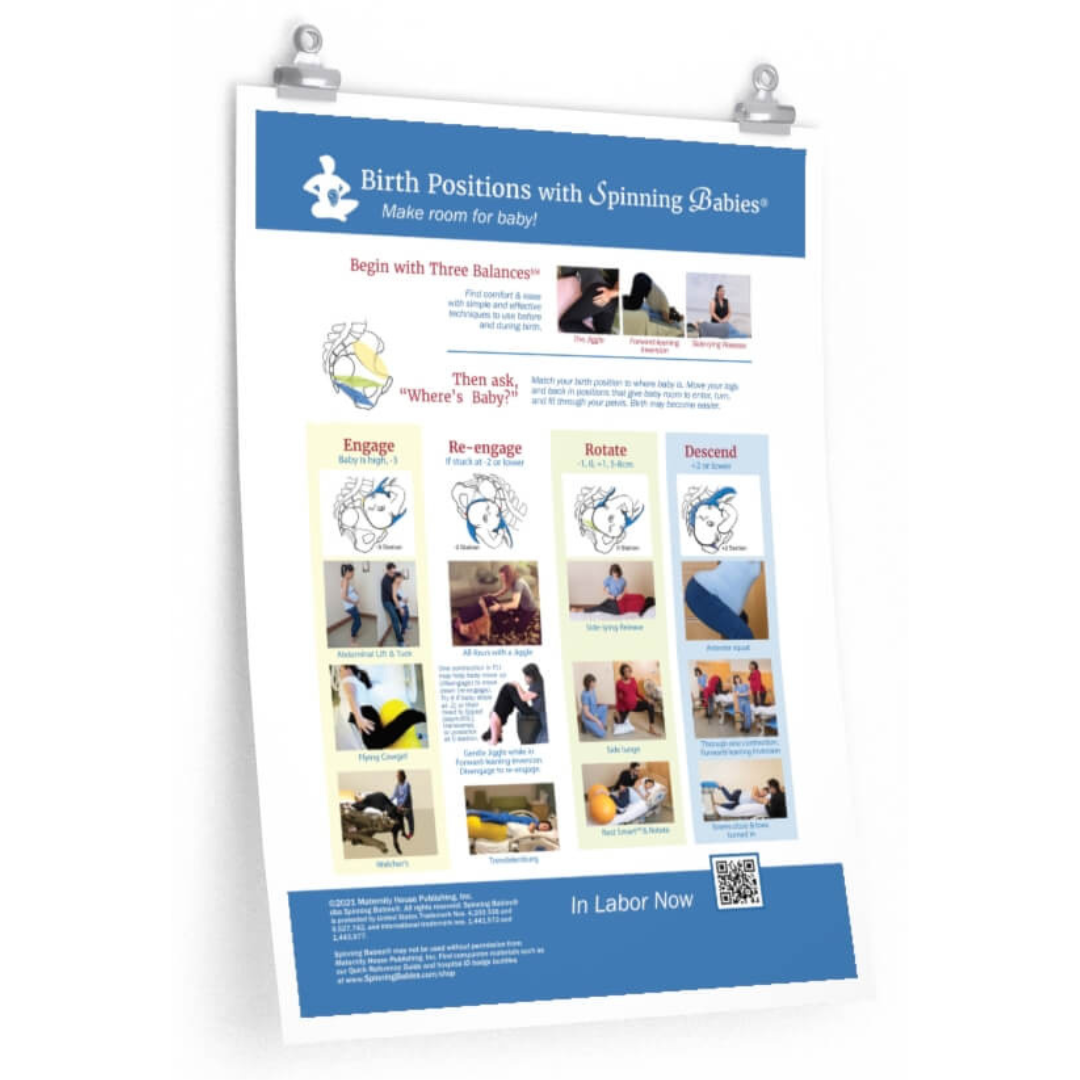
Forward-leaning Inversion: Do this every day for 30 seconds each time. After 36 weeks, do 2-3 a day for only 30 seconds each time.
Side-lying Release: Once a day while baby is oblique, and in early labor to help straighten baby vertically over your pelvis. It can be repeated in labor if necessary.
Dip the Hip with loose hip joints for 15 minutes a few times a day. See directions.
If you find yourself with a baby in an oblique lie while you are in labor, you may have a chance to slip your baby head down. If you do, you can avoid a cesarean. Do the Side-lying Release first, through 1-3 contractions on each side. You must do the release on the left and on the right! See the article for more. Then, when standing if possible, do the lunge 3-6 times on each leg. See the article describing the lunge. It works with the contractions.
You may find some helpful information on what to do in labor for the asynclitic baby (a tipped head during birth). If the reason for an oblique lie continuing after 30 weeks isn’t completely resolved by labor, there may be a higher chance of asynclitism. I don’t “know” that by data, but it makes sense.
Twins? Oblique is not uncommon for a second twin. If the first is born vaginally, and you find the second twin remains oblique, simply lift that leg as in a lunge, whether standing or on your side through a contraction or two. The baby will slip head down during the contraction. Repeating the Side-lying Release in labor may also help any oblique lie whether 1 or 2 or more babies. Begin SLR before 3 cm as a preventative measure.
A similar article, here on Spinning Babies®, to serve your baby’s position is the one about the Transverse Lie, and while the fetal position is not exactly the same, the solutions are often the same.